Creating a Company of “Owners”
Activating Strategies and Cultures

Imagine how your company would look and perform if every single person at every level really understood why your company needs to change, what most needs to change, and how they contribute to “us” winning.
Think it is impossible to truly engage all of your employees in the big picture so they can work together to help your business succeed?
Think again!


Many may scoff at the idea that it’s possible to get every person in the organization to understand everything it takes to run a successful business. It’s not only possible, it should be the norm for every organization.
When employees don’t really have a grasp of the direction of the company, it creates a number of other potential challenges – lack of employee engagement, reduced productivity, poor levels of customer services – to name a few.
“Strategy without execution is meaningless.
Execution without engaged people is impossible.”
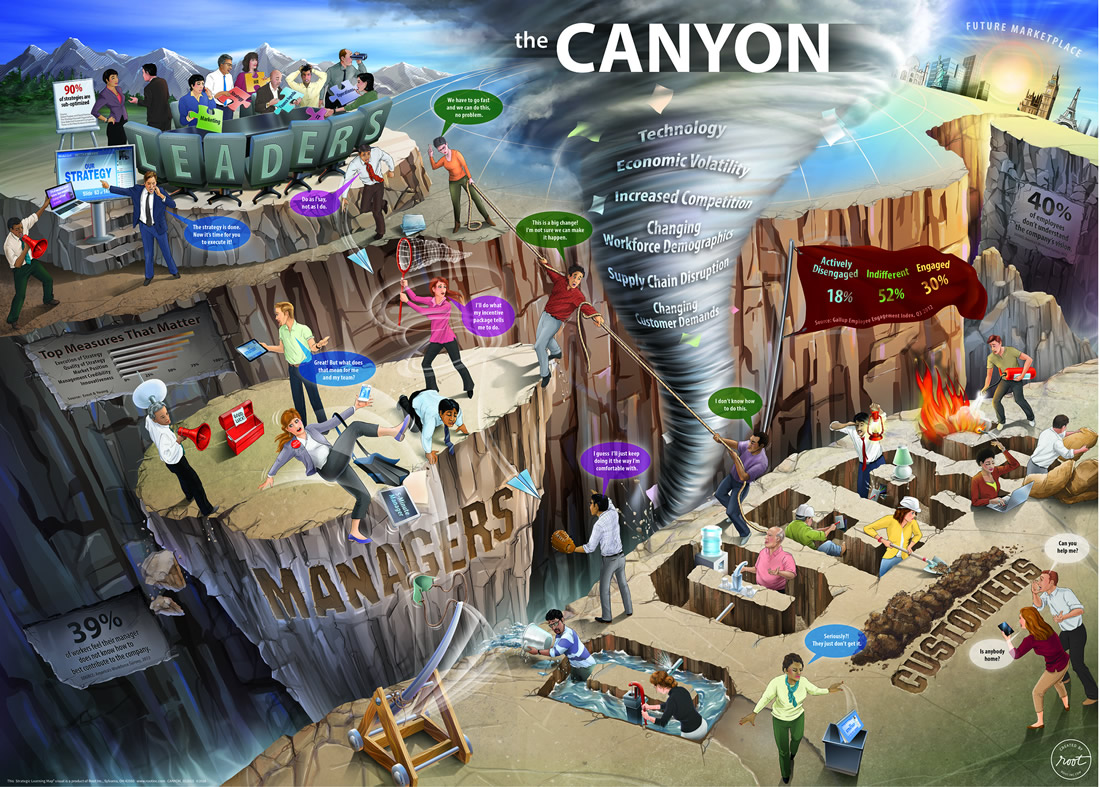
By creating relevance and telling the stories of the business in a way that makes sense to their people, leaders will begin to successfully engage their people to execute strategy. So what’s holding companies back from making this a reality?
What’s actually going on is that there is a “Grand Canyon” between the leaders, who can see what needs to be done, but don’t have their hands on the levers of change, and the doers, who have their hands on the levers of change but who simply can’t see the big picture.
Leaders say, “This is our vision.” Doers reply, “What does this mean for me and my people?”
For any strategy or change initiative to truly be successful, organizations need to bridge those canyons. And, the only way to bridge that canyon is to provide everyone with a comprehensive, board-level understanding of the most strategic business issues.
As organizations set out on the process of bridging the canyons, it’s important to keep these realities in mind:

“In many cases, organizations and leaders treat engagement of people in the strategy as a series of loosely connected events.”
Strategic engagement must be approached as a process. In many cases, organizations and leaders treat engagement of people in the strategy as a series of loosely connected events. Roles are not clearly defined and no one seems to truly own strategic engagement.
Some people think human resources or communications owns it; maybe the chief financial officer owns financial results and the chief operations officer owns operational tactics.
If no one owns where all of these critical issues comes together, how can organizations expect their people to see all of the connections and co-dependencies of the elements of strategic engagement? They can’t, so the leadership team must own this process together.

How can organizations help their people quickly understand the most complex business issues? First, people learn visually. Aristotle said, “The soul never thinks without a picture.” Let’s take it one step further: “If a picture is worth a thousand words, a metaphor is worth a thousand pictures.”
Visualization is an accelerant tool. As people absorb new information, it forms a picture in their minds. This picture emerges only when people can create links between their existing knowledge and new information.
Visualizing critical business issues allows individuals, teams, and organizations to think in systems, greatly speeding up the “aha” process. It also creates focused thinking, helping everyone build a shared understanding of the larger systems that determine the effectiveness of their individual actions.

If visualization is the first tenet, the second is dialogue – specifically, strategically directed Socratic dialogue. Socrates recognized that learning and change are a matter of asking the right questions, not simply giving the right answers. He developed a system of asking his students questions to get to core truths. He avoided presenting his own conclusions; instead, he sought to immerse learners in exploration and inquiry.
In business, there are few sustainable right or wrong answers; there are simply better questions. The better the question, the more people will participate in engaged thinking.
Dialogue demands that cherished assumptions be challenged, that long-held beliefs be explored. Strategically directed dialogue can tackle business issues. This may sound like a simple exercise, but it is very hard to master. Most leaders lecture; most teachers preach. True dialogue seeks to minimize the leader/teacher talk and maximize the learner search.
Successful leaders know that their first responsibility is to define the reality of the business. The second is to create hope.
The process of executing major improvements rests on a widespread employee understanding of the competitive, economic, technological, customer, market, and environmental realities that drive your business.
A person who doesn’t have that understanding may not accept responsibility for the future of the organization. A person with this information can’t help but accept responsibility.
By appealing to the highest level of thinking in people, leaders ensure the highest level of actions, commitment, and organizational “alignment.” Business and strategy literacy are essential to make people effective players who know how to keep score on the results.
People must have a basic understanding of how a business operates and what it takes to win if they are to participate successfully in improving it.