
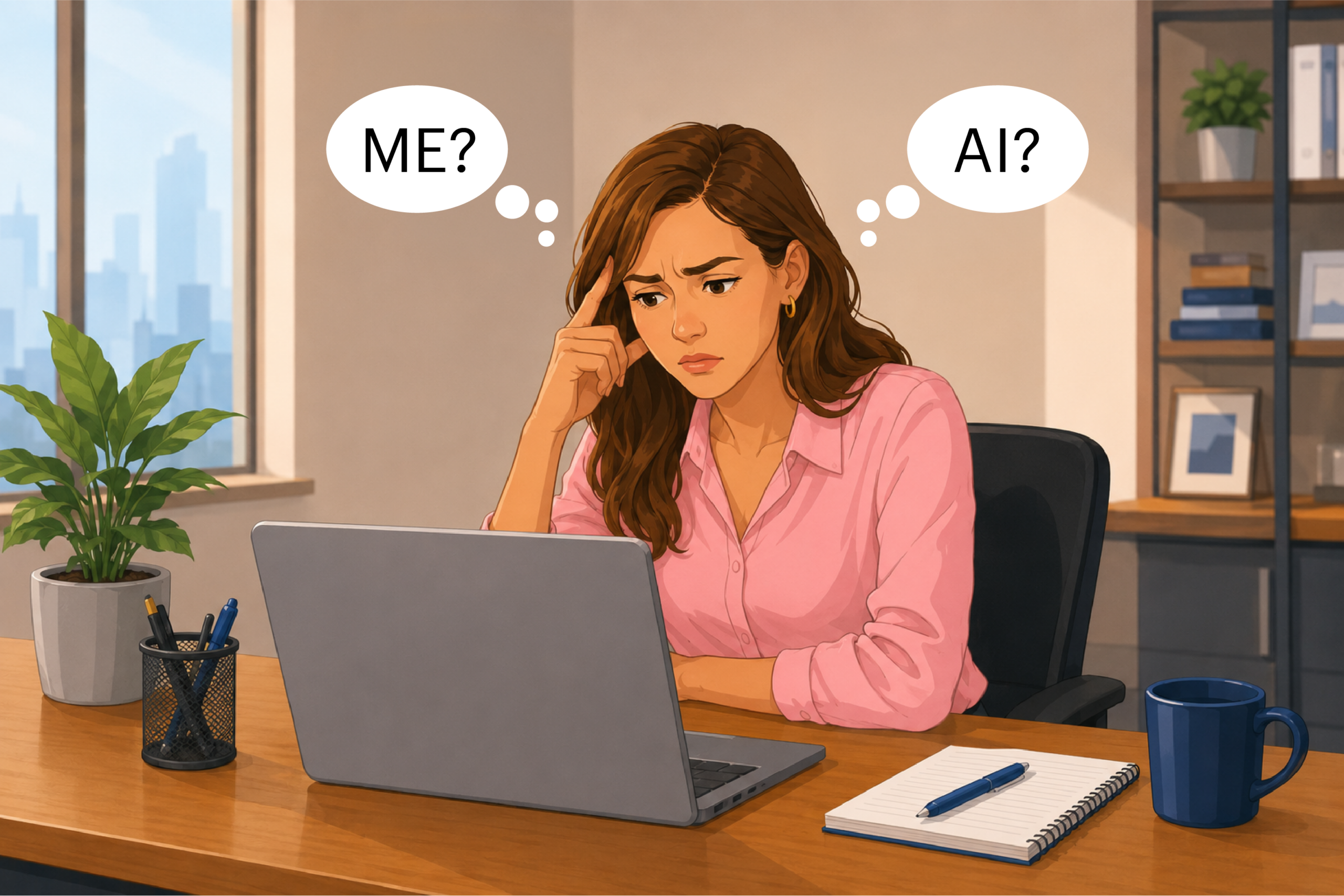
Most employees aren’t resisting AI because they hate technology. They’re trying to figure out where they still fit.
Do my skills still matter? Will my role change? Am I being empowered, or replaced?
That question isn’t uncertainty. It’s fear. And you can see it everywhere if you actually look. Not in the boardroom, where people are still saying the right things, but on TikTok, in the group chats, in the 22-year-old asking if their degree was a mistake and the mid-career people quietly wondering if they’ll ever be hired again. The feeling in a lot of workplaces right now isn’t change fatigue. It’s dread. And pretending otherwise in a town hall is exactly the kind of gap between messaging and reality that people are very good at spotting.
This Isn’t New
I’ve seen versions of this before. Not with AI specifically, but with almost every major transformation I’ve been around.
One in particular stays with me.
The kickoff was strong. People were engaged. The strategy made sense. For a moment, it felt like real momentum.
And then reality showed up. Competing priorities. New requests. Additional reporting. More initiatives layered on top of work that was already full.
The same people we had just energized were suddenly trying to survive. The behaviors we were hoping to create disappeared under the weight of the day-to-day tasks. Not because anyone stopped caring, but because nobody had room left.
What That Moment Taught Me
That experience taught me something I’ve never forgotten. Most organizations don’t have a motivation problem during transformation. They have a human capacity problem. We activate people in the moment and then bury them in competing priorities the next morning.
It’s happening right now with AI.
Organizations are asking employees to keep hitting their numbers, keep doing their current jobs, learn entirely new tools, experiment with new ways of working, move faster, be more innovative, and somehow stay confident through all of it.
That’s a lot. And the response from most companies has been more communication, more presentations, more training, and more change management.
But this isn’t primarily a technology challenge. It’s a human one. And companies have the right intentions. They almost always do. They spend enormous money building the strategy and rolling it out. What they miss is that if you don’t activate it in a way that actually means something to people, you can undermine the entire investment.
Where I Learned This Most Clearly
I’ll tell you where I learned this most clearly: healthcare.
People sitting around a table together, working through complex information with their peers, making sense of it out loud. Not an app. Not a portal. Not another PDF. Patients managing chronic disease across more than a hundred countries, all responding to the same simple human thing. Being part of figuring it out rather than being told.
That’s the part most organizations still underestimate. We spend enormous energy telling people things more clearly. But people rarely change because they were told something. They change when they wrestle with an idea themselves. When they hear peers process it. When they connect it to their own reality and arrive at a conclusion that feels personally true.
And it works the same way with physicians, patients, employees, and leaders, because the truth underneath it is human, not industry specific.
What the Winning Organizations Will Have in Common
Which is why I believe the organizations that succeed with AI won’t necessarily be the ones with the best technology. They’ll be the ones that recognize something deeply human is happening underneath it. That create space for people to engage instead of just comply. That help employees make sense of what’s changing instead of announcing it at them.
Because human beings don’t want to be managed through change. They want to make sense of it.
When they do, something shifts. Change stops being something done to them. And they start helping move it forward.
The companies that figure this out won’t be the ones with the loudest AI strategy. They’ll be the ones whose people aren’t afraid.